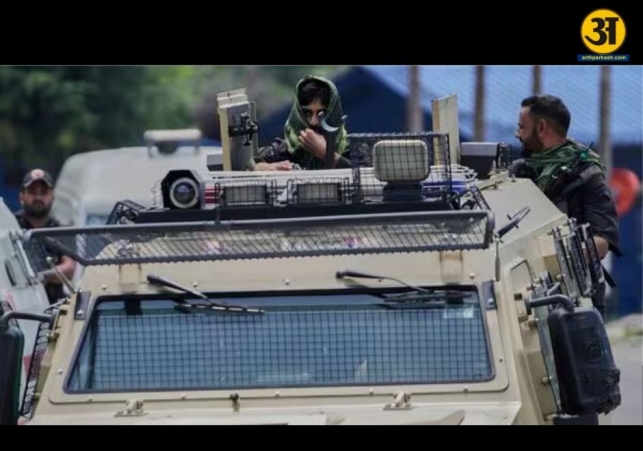
Chinese device helps trace Pahalgam attack planner in J-K
Chinese gadget leads security forces to mastermind of Pahalgam terror strike in J-K
- By Gurmehar --
- Friday, 01 Aug, 2025
The recent Operation Mahadev in Jammu and Kashmir sends a strong message to terror groups operating in the region. Union Home Minister Amit Shah announced in Parliament that three terrorists involved in the April 22 Pahalgam attack were killed by Indian forces in a joint operation on July 29. Among them was Suleman alias Faizal, believed to be the top Lashkar-e-Taiba (LeT) commander behind the deadly attack that had claimed 26 innocent lives, many of them tourists.
The joint operation by the Indian Army, CRPF, and J&K Police was launched after weeks of tracking, with intelligence teams keeping a close watch for clues. After the April attack, security agencies were under intense pressure to deliver results. What finally helped break the case open was a suspicious radio signal. This signal came from a Chinese-made ultra-radio device, which was being used by the terrorists to send secret messages.
Reports say the device had been activated again just two days before the final operation, and this gave Indian forces the lead they needed. The Chinese gadget, often used by LeT operatives, became the very reason they were traced.
Local support also played a vital role. Nomads in the Dachigam forest area gave important tips that helped narrow the search. Surveillance drones were then used to confirm the location of the terrorists. Once their presence was confirmed in the Mahadev hill region, elite commando units of Rashtriya Rifles and Para SF were deployed. Using stealth and detailed planning, they neutralised all three terrorists in a short, focused battle.
Technology, intelligence, and local help
What stands out in this operation is how technology, local help, and ground-level intelligence worked together. The terrorists likely thought they were safe using advanced encrypted communication, but their own device betrayed them. This is a reminder that in today’s world, no signal truly goes unnoticed if the agencies are determined and alert.
This also shows that modern counter-terror operations are no longer just about gun battles, but depend heavily on cyber intelligence, signals interception, drone footage, and even human inputs from the local population. The fight against terrorism has evolved, and so has India’s approach.
The Pahalgam terror attack was not just another act of violence—it was a symbolic attempt to shake India’s peace in Kashmir, especially as it involved the killing of innocent tourists. This was one of the deadliest attacks after the removal of Article 370 in 2019. By responding with force and precision, India is telling the world that such attacks will not go unanswered.
In fact, even before Operation Mahadev, Operation Sindoor was carried out on May 7, in which Indian Armed Forces reportedly struck terror camps in Pakistan and PoK. That operation targeted Jaish-e-Mohammed (JeM) and LeT bases, and even led to the killing of family members and aides of JeM chief Maulana Masood Azhar. It was a bold move that had Pakistan on the backfoot.
Both Operation Sindoor and Mahadev show India’s new counter-terror strategy: swift action, high-level intelligence coordination, and no tolerance for those sheltering or supporting terrorists.
ALSO READ: Divya Deshmukh checkmates history to become India’s first Women’s World Cup champion
ALSO READ: Subtle signs of anxiety you might be missing in everyday life
A bigger picture beyond just one mission
Operation Mahadev is not just about avenging the Pahalgam attack. It represents a shift in India's internal security policy, especially in Kashmir. The government is clearly relying more on tech-based tracking, real-time surveillance, and strong local intelligence networks to eliminate terror threats.
However, it also raises important questions: Why are Chinese communication devices so easily available to terrorists? How do these gadgets enter Indian territory? The government must work on stronger border surveillance and trade monitoring, especially with neighbouring countries like China and Pakistan, who are known to be friendly with anti-India groups.
There’s also the challenge of keeping the local population supportive of security forces. In this case, the help from nomads proved crucial. But maintaining public trust requires regular engagement, fair treatment, and protection of civil rights, especially in conflict zones like Kashmir.
In the end, it is important to realise that victory in one operation does not mean the war is over. Terror groups may try again. But if every such act is met with a strong, united, and smart response like Operation Mahadev, it will reduce their confidence and resources.
India needs to stay on alert, continue building strong ground intelligence, and invest more in modern warfare and cyber tools. Terrorism today does not need large armies or borders—it runs on signals, apps, and encrypted radios. The response must match that level of complexity.
Operation Mahadev has done that. It has honoured the memory of those lost in Pahalgam and sent a chilling warning to those who plan such evil again.
Related News